Debugging a self-hosted LLM performance regression on legacy hardware
A developer diagnosed a severe slowdown in a 125B parameter model running on two Tesla P40 GPUs, tracing the issue to a single code change in the inference engine.
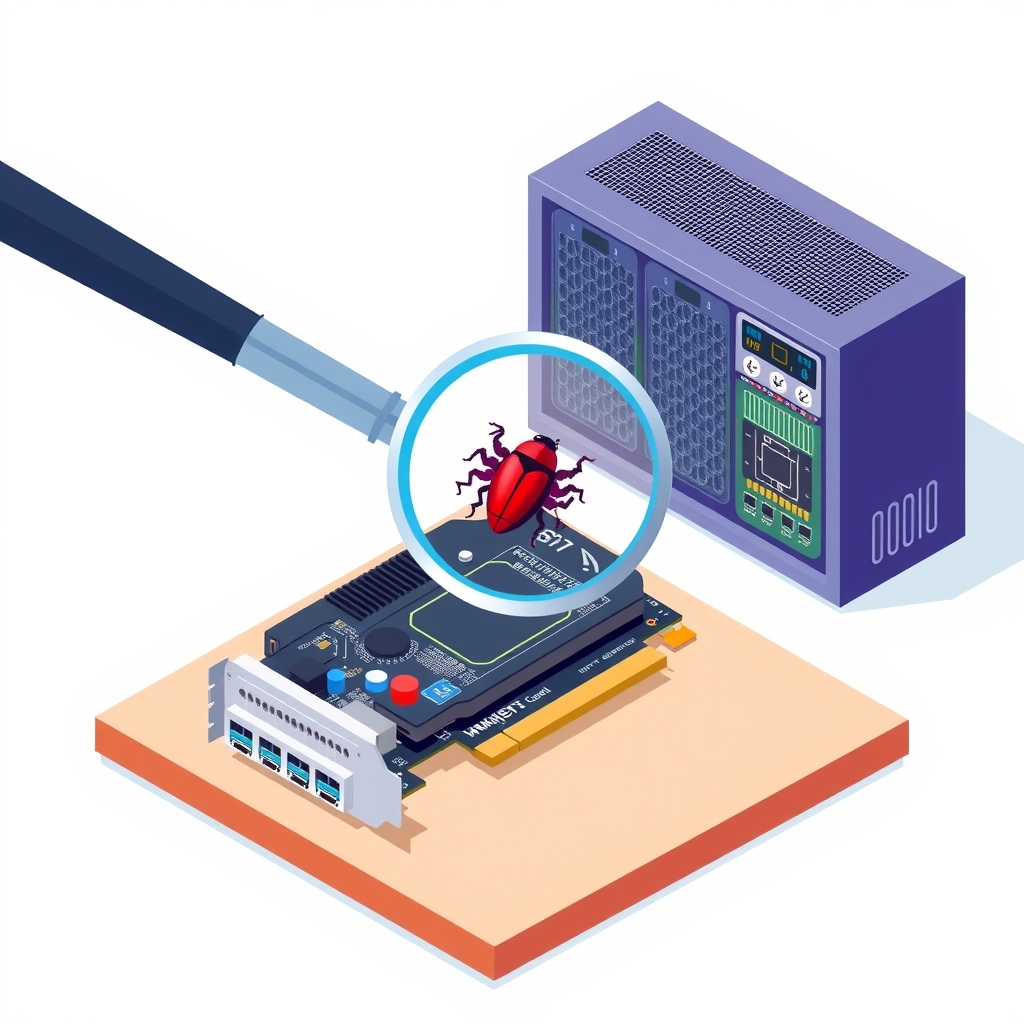
A developer running a large language model on older consumer hardware experienced a sudden drop in inference speed that lasted for a week. By systematically ruling out configuration and hardware issues, they traced the problem to a specific version of the open-source Strata engine. The resolution came from a community bug report that identified a single line of code responsible for the regression.
What happened
The setup involved an EPYC 7302 server with 128 GB of RAM and two Tesla P40 graphics cards purchased for $403. These cards are based on the Pascal architecture from 2016, lacking modern features like Tensor Cores. Despite the age of the silicon, the system was running Qwen3.8-Flash-Next, a mixture-of-experts model with 125 billion parameters. The Strata inference engine managed this by keeping most expert weights in video memory, achieving a 99.9% cache hit rate.
For a week in October, the system decoded text at only 17 to 18 tokens per second. This was significantly slower than the 23 tokens per second achieved by a smaller, dense model on the same hardware. It was also slower than the upstream llama.cpp engine running the same weights. The developer spent days testing various hypotheses, including changing the parallelism strategy, removing container overhead, and adjusting batch sizes. None of these changes improved the single-stream decode speed.
The breakthrough came when the developer found a bug report filed by another user on the Strata project tracker. The report noted that version 0.1.40.2 ran at half the speed of version 0.1.40.0 on similar Pascal hardware. The maintainer had identified that a recent commit removed a __restrict__ keyword from activation pointers and added a prefetch instruction that Pascal architectures cannot overlap with computation. Reverting to version 0.1.40.4, which included the fix, doubled the decode speed to over 35 tokens per second.
Key details
- The hardware consisted of two Tesla P40 GPUs, which have compute capability 6.1 and no NVLink support.
- The performance regression affected Strata versions 0.1.40.2 and 0.1.40.3, dropping speeds from ~36 to ~17 tokens per second.
- The root cause was a code change that introduced a prefetch instruction incompatible with the Pascal architecture's execution pipeline.
- Community member paulhothersall filed issue #1469, providing benchmark data that isolated the problematic version range.
- Maintainer Niko1221 pushed a fix approximately 75 minutes after the issue was filed, restoring the
__restrict__keyword. - Upgrading to version 0.1.44.1 provided an additional 8% speed increase, but required holding certain defaults off to ensure consistent output.
Background
Mixture-of-experts models split their parameters into multiple groups, activating only a small subset for each token generated. This allows models with hundreds of billions of parameters to run on hardware with limited memory, as only the active experts need to be loaded quickly. The Strata engine optimizes this by pinning a large arena of experts in host RAM and caching frequently used ones in GPU video memory. This minimizes data transfer over the PCIe bus, which is often a bottleneck in multi-GPU setups.
The __restrict__ keyword in C++ tells the compiler that two pointers do not point to overlapping memory regions. This allows the compiler to generate more efficient machine code by avoiding unnecessary memory reloads. When this hint is removed, or when inappropriate prefetch instructions are added, the CPU or GPU may stall while waiting for data, especially on older architectures that lack advanced out-of-order execution capabilities. This is why the bug only affected older Pascal cards and not newer hardware.
Why it matters
For teams running self-hosted AI infrastructure, this case highlights the importance of monitoring software versions closely. Performance regressions can occur without any changes to local configuration or hardware. In this instance, the slowdown was caused by an upstream update that inadvertently broke compatibility with older but still widely used hardware. Without careful version tracking, such issues can lead to wasted engineering time spent debugging non-existent local problems.
It also demonstrates the value of community-driven open source projects. The bug was found and fixed rapidly because users shared detailed benchmark data. For organizations relying on niche or legacy hardware, engaging with project issue trackers can provide faster resolutions than internal troubleshooting. The transparency of the Strata project allowed the developer to see exactly which commit caused the issue, enabling a quick rollback and verification.
Finally, the story underscores that raw token generation speed is not the only metric that matters. Even after doubling the speed, long "thinking" phases in complex models can result in significant latency before any text appears. Teams must balance engine optimization with model behavior to meet user experience expectations.
What you can do
- Check the issue trackers of your core dependencies when experiencing unexplained performance drops, even if your configuration has not changed.
- Pin specific versions of inference engines in production environments to prevent unexpected regressions from automatic updates.
- Compare your benchmark results against public reports from other users with similar hardware to identify if an issue is widespread.
- Test new engine versions with default settings held constant to isolate performance changes from behavioral changes in the model.
- Use per-request overrides for tuning parameters like draft token gates to test improvements without restarting the entire service.
- Maintain a rollback plan, such as keeping previous Docker images, to quickly revert to a known good state if an update fails.